
For years, storytelling on social media seemed impossible without a camera.
Creators filmed themselves talking. Brands hired videographers. Agencies coordinated shoots, lighting, editing, and talent. The assumption was simple: if you wanted engaging video content, you had to be on camera.
That assumption is now outdated.
AI has quietly changed the rules of content creation. Today, creators and businesses can tell compelling stories through visuals, voiceovers, motion graphics, and AI-generated scenes—without ever pressing the record button.
In this article, we’ll explore how storytelling without a camera works, why it’s becoming so popular, and how AI tools are making it accessible to anyone.
Why Traditional Video Storytelling Feels So Difficult
Most creators don’t struggle with ideas; they struggle with production.
A single 30-second video often requires:
- planning a concept,
- writing a script,
- setting up a camera,
- recording multiple takes,
- editing footage,
- adding captions,
- finding music,
- exporting for different platforms.
For small businesses, creators, and agencies, this process is expensive and time-consuming. Many people stop posting consistently simply because the production burden is too high.
That’s where AI enters the picture.
What Is “Storytelling Without a Camera”?
Storytelling without a camera means creating an emotional narrative without filming yourself or your environment.
Instead of live footage, the story is communicated through:
- AI-generated video scenes,
- cinematic visuals,
- animated text,
- synthetic voiceovers,
- music and sound design,
- stock footage enhanced by AI,
- visual metaphors and transitions.
The audience still experiences a beginning, conflict, and resolution—the core elements of storytelling—even though no camera was used.
Think of it as directing a story rather than recording one.
Why AI Storytelling Works
Humans respond to stories, not equipment.
A viewer scrolling TikTok or Instagram rarely asks, “Was this filmed on a DSLR?” They ask:
- Does this feel relevant to me?
- Does it capture my attention?
- Does it create curiosity or emotion?
AI-generated content can do all three when the narrative is strong.
Example
A skincare brand could tell this story without filming a single person:
- Problem: “I spent years trying products that never worked.”
- Struggle: Visuals of cluttered skincare shelves and frustration.
- Discovery: AI-generated scenes of a simplified routine.
- Transformation: Clean visuals, confident mood, and a clear outcome.
The emotional arc remains intact even without a camera.
The New AI Storytelling Workflow
Modern AI video tools have compressed the entire production process into a few steps.
1. Start with an idea
One sentence is often enough.
“A founder overwhelmed by content creation discovers a faster workflow.”
2. Generate the script
AI expands the idea into a short-form narrative optimized for TikTok, Reels, or Shorts.
3. Create visuals automatically
AI generates scenes that match the script.
4. Add voiceover and music
Natural-sounding AI voices narrate the story while background music supports the emotion.
5. Export a ready-to-publish video
The result is a complete short-form video in minutes rather than hours.
This is why many creators are now producing multiple videos per day instead of one video per week.
Who Benefits Most from Camera-Free Storytelling?
Content creators
- Post consistently without being on camera every day.
- Test more hooks and niches quickly.
D2C brands
- Produce product storytelling videos without organizing photo or video shoots.
- Create social proof, problem-solution, and educational content at scale.
Agencies
- Deliver more creative variations to clients.
- Reduce editing and production bottlenecks.
Introverts and privacy-conscious creators
- Build an audience without revealing their face.
The Biggest Advantage: Consistency
Consistency is one of the strongest predictors of social media growth, yet it is also the hardest habit to maintain.
AI storytelling lowers the activation energy required to publish. When creating a video takes five minutes instead of five hours, posting regularly becomes realistic.
More consistency leads to:
- more data,
- more audience feedback,
- more optimized content,
- and ultimately more growth opportunities.
Common Misconceptions About AI Storytelling
“AI videos feel fake.”
Poor prompts create poor videos. Strong prompts and strong scripts create surprisingly engaging content.
“Audiences only trust real people.”
Audiences trust authenticity, clarity, and usefulness. Many successful faceless channels generate millions of views because the content solves a problem.
“AI replaces creativity.”
AI accelerates execution; it does not replace strategy, taste, positioning, or storytelling judgment.
A Practical Storytelling Template
Use this structure for your next camera-free video:
Hook (0–3 sec)
“I almost quit posting content because this took me 4 hours a day.”
Problem (3–10 sec)
Describe the frustration.
Discovery (10–20 sec)
Introduce the new method or tool.
Transformation (20–35 sec)
Show the improved outcome.
Call to action (35–45 sec)
Invite the viewer to learn more.
This framework works for creators, coaches, e-commerce brands, SaaS products, and agencies.
Where AI Tools Fit In
Tools such as KOL Studio are designed specifically for this new style of content creation. Instead of manually assembling scripts, visuals, voiceovers, music, and exports, the workflow is automated into a single process, making camera-free storytelling practical even for non-editors.
The important shift is not the software itself—it is the realization that video production no longer requires filming.
The Future of Storytelling
We are moving from the creator economy to the story economy.
The creators and brands that win will not necessarily be those with the best cameras. They will be the ones who can generate relevant stories quickly, test them continuously, and publish consistently across TikTok, Instagram Reels, and YouTube Shorts.
AI makes that possible.
You still need an idea. You still need empathy for your audience. You still need a compelling narrative.
But you no longer need a camera to start.
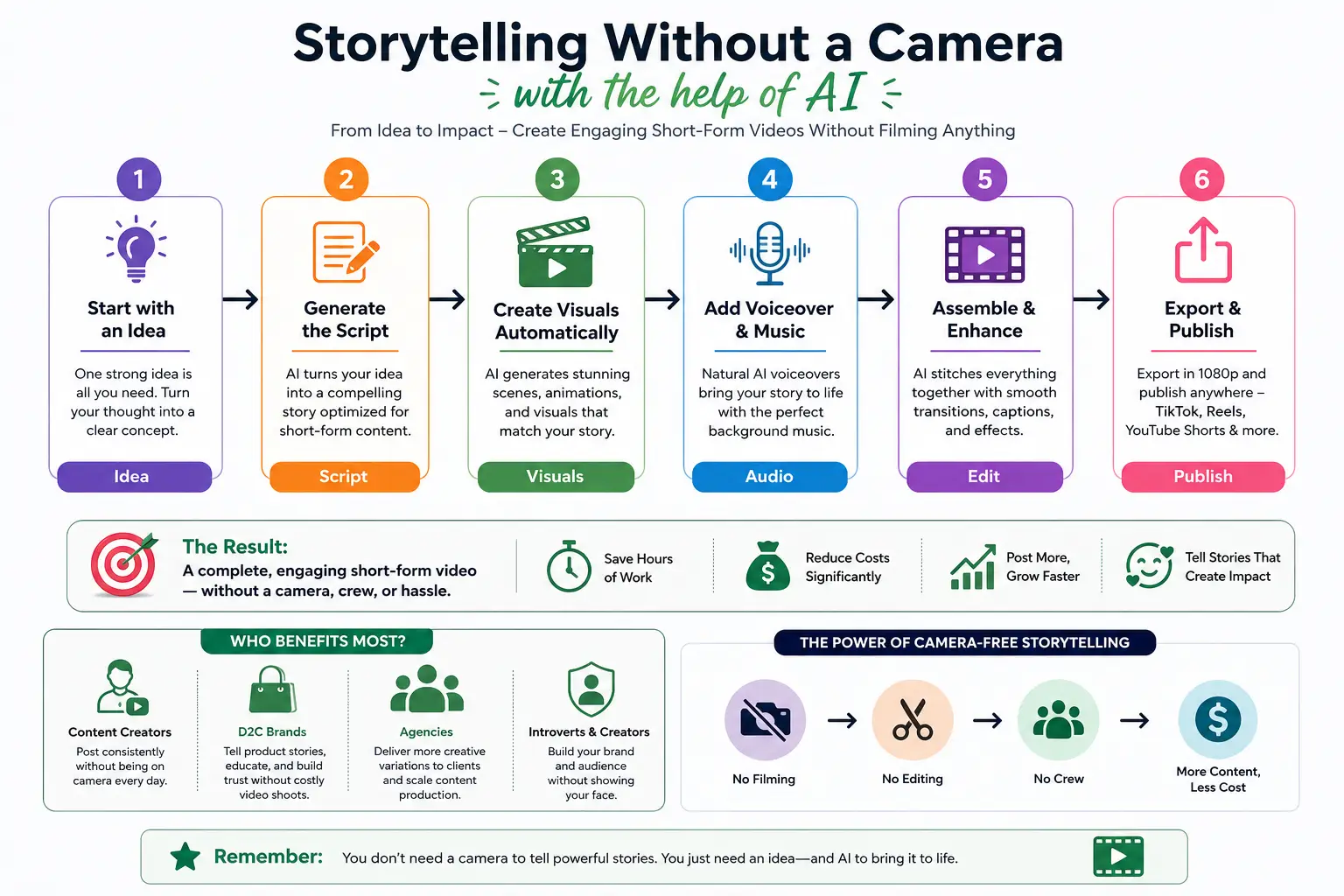
Storytelling without a camera is not a temporary trend—it is a fundamental shift in digital content creation.
AI has removed many of the technical barriers that kept people from publishing video content. For creators, brands, and agencies, this means faster production, lower costs, greater consistency, and the freedom to focus on what matters most: the story itself.
If you’ve been waiting until you had better equipment, better lighting, or more confidence on camera, this is your reminder that the most important storytelling tool today may not be a camera at all.
It may be your idea—and an AI system that can bring that idea to life in minutes.